
Why look for a quality mattress for everyday sleep
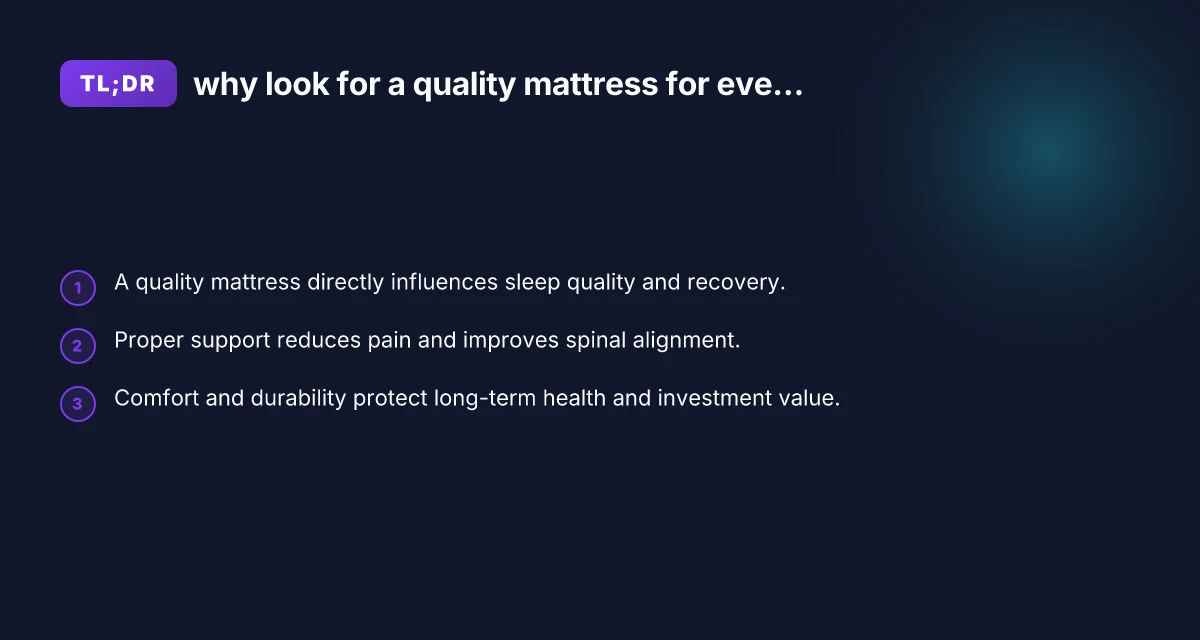
A quality mattress supports better rest daily, boosting health, mood, and longevity of sleep.
An excellent night’s sleep starts with the foundation you rest on: a quality mattress designed for everyday sleep. When you choose well, you don’t just fall asleep faster, you wake up refreshed, with less stiffness, fewer aches, and sharper focus. For most adults, a good mattress is not a luxury. It’s a nightly health habit that supports the body’s needs day in and day out.
Comparison of mattress quality factors for everyday sleep
| Factor | What it means | How to assess | Typical guidance |
|---|---|---|---|
| Support | Proper spinal alignment | Check firmness vs weight | Medium-firm common |
| Comfort layer | Surface feel | Press test; sinkage | Moderate give preferred |
| Durability | Longevity under use | Look at materials; warranty | Durable materials preferred |
| Motion isolation | Transfer between sleepers | Spin, roll test; edge effect | Higher is better for shared bed |
| Temperature regulation | Sleep temperature | Inspect breathable covers | Cool sleep is ideal |
| Edge support | Sleep area near edges | Sit/lie near edge | Strong edges helpful |
Compiled November 2026; check the provider's site for current details.
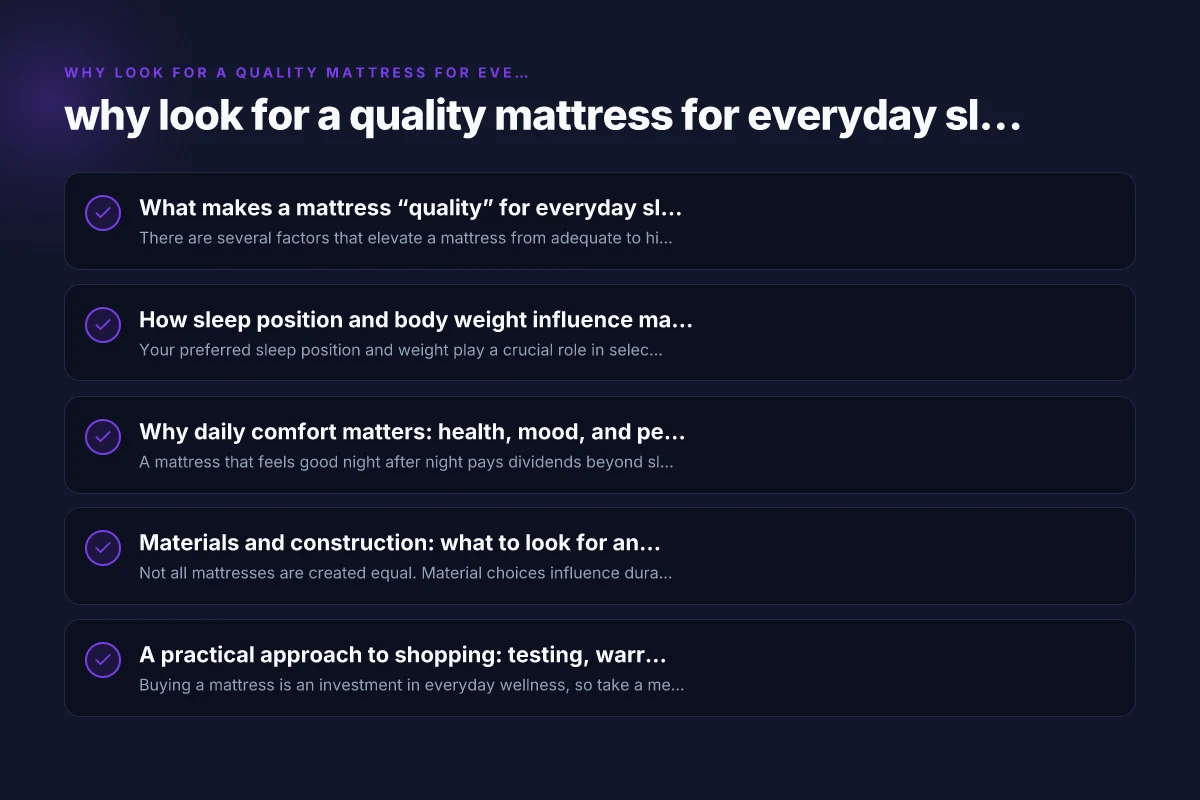
What makes a mattress “quality” for everyday sleep
There are several factors that elevate a mattress from adequate to high-quality for daily use. Understanding these can help you compare options more confidently.
- Support and alignment: The spine should stay in a neutral position. A mattress that saggs or cushions unevenly can cause back and neck strain.
- Comfort layer: This is the surface your body rests on. It should balance softness with support to reduce pressure points.
- Durability: Everyday use requires a mattress that maintains its feel and alignment over years, not months.
- Motion isolation: If you share a bed, a quality mattress minimizes partner movement transfer so your sleep stays uninterrupted.
- Breathability and temperature control: A mattress that sleeps cool helps you avoid night sweats and restless tossing.
- Construction clarity: Clear product details about materials, density, and warranty help you assess value and safety.
Different types, memory foam, hybrid, latex, and traditional innerspring, each bring a distinct balance of these qualities. The right choice varies by body type, sleep position, and personal preferences. The key is finding a model that holds up under nightly use while delivering consistent comfort and support.
How sleep position and body weight influence mattress choice
Your preferred sleep position and weight play a crucial role in selecting a mattress. What works for one person may be uncomfortable for another.
- Back sleepers: Often benefit from medium-firm support to maintain spinal alignment without creating pressure on the hips.
- Side sleepers: Typically need a slightly softer surface to cushion shoulders and hips, but not so soft that the hips sink and misalign the spine.
- Stomach sleepers: Usually require firmer support to prevent the pelvis from dipping and straining the lower back.
- Heavy individuals: May need firmer support and higher density materials to prevent sagging and provide long-lasting resilience.
- Light individuals: Might prefer a softer top layer for pressure relief without sacrificing overall support.
Keep in mind that a mattress’s feel can change with weight distribution. A test period that includes a variety of sleeping positions can help you gauge long-term satisfaction. If you share a bed, consider a model with good edge support and balanced motion isolation to minimize disturbances. Craftsmanship and Elegance: The Hallmarks of Luxury Furniture
Why daily comfort matters: health, mood, and performance
A mattress that feels good night after night pays dividends beyond sleep metrics. Here are some practical benefits of prioritizing daily comfort:
- Pain reduction: Proper support can alleviate sleep-related aches in the back, neck, hips, and shoulders.
- Improved sleep efficiency: Less tossing and turning often translates to longer, more restorative sleep cycles.
- Mental clarity: Deep rest supports memory, focus, and decision-making the next day.
- Mood stability: Consistent sleep reduces irritability and emotional volatility.
- Immune and metabolic health: Regular, high-quality sleep contributes to hormonal balance and recovery processes.
- Longevity of daily energy: Consistent rest helps you perform tasks with greater stamina and fewer midday crashes.
Quality mattresses often come with design elements that directly address these areas, such as zoned support in the core (to align with the body’s curves) and breathable covers to regulate temperature. If you experience chronic pain or sleep disturbances, a mattress upgrade can be a foundational part of a broader health strategy.
Practical shopping criteria by sleeper profile
| Profile | Priority factors | Mattress types to consider | What to test in-store |
|---|---|---|---|
| Back sleeper | Support, alignment | Medium-firm innerspring or latex | Firmness, back support |
| Side sleeper | Pressure relief, softness | Foam, hybrid, or latex soft-medium | Hip/shoulder comfort; over-soft risk |
| Heavy weight | Durability, support | Dense foam, latex, high-density hybrid | Sag resistance; edge support |
| Petite / light | Comfort, responsiveness | Softer foams, softer hybrids | Ease of movement; no sinking |
| Couples | Motion isolation, cooling | Hybrid or memory foam with good isolation | Toss/turn; temperature test |
Compiled November 2026; check the provider's site for current details. Tips to Combine Different Office Seating Options for a Dynamic Workspace
Materials and construction: what to look for and why it matters
Not all mattresses are created equal. Material choices influence durability, feel, temperature, and safety. Here’s a quick guide to common materials and what they tend to offer:
- Memory foam: Excellent contouring and pressure relief. Can retain heat unless layered with breathable technologies.
- Latex: Responsive and durable. Tends to sleep cooler than memory foam and offers natural resilience.
- Hybrid: Combines innerspring support with foam or latex comfort layers. Aims to balance bounce, support, and temperature control.
- Innerspring: Traditional coil systems with various comfort layers. Strong edge support is common but may feel less contouring.
- Gel and phase change materials: Supplemental tech to improve cooling in some models.
- Covers and fabrics: Look for breathable, dust-m mite resistant fabrics. Natural fibers like cotton or Tencel can aid airflow.
When evaluating, consider:
- Density and ILD (indentation load deflection) ratings for support and feel.
- Coil gauge and system design in hybrids for durability and motion control.
- Certifications that relate to safety and indoor air quality (for example, CertiPUR-US for foams).
A thoughtful combination of materials often yields better daily performance than chasing a single “best” category. If you tend to sleep hot, prioritize cooling features and breathable covers. If you’re sensitive to motion, look at models with strong motion isolation.
A practical approach to shopping: testing, warranties, and guarantees
Buying a mattress is an investment in everyday wellness, so take a methodical approach: Reasons you may benefit from using a medical massage pain relief lift chair
- Try before you buy: If possible, spend at least 15–30 minutes lying in your typical sleeping positions in a store, and ask about trial periods.
- Trial period: Many brands offer 90–120 nights to test at home. A generous trial helps you adapt to the new feel and assess long-term comfort.
- Return policy and exchanges: Confirm flexible options if the mattress isn’t working for you. Some brands offer free returns or exchanges with no heavy fees.
- Warranty: A solid warranty covers structural failures like excessive sagging and zipper malfunctions, typically 10 years or more.
- Financing and price: Look beyond the sticker price. A high-quality mattress is an investment in health. Consider value over time and the cost per year of use.
- Sleep environment compatibility: Make sure your bed frame, foundation, and bed linens won’t negate the mattress’s benefits. A supportive foundation is essential.
Table: quick comparison guide for common mattress types
| Mattress type | Pros | Cons | Best for |
|---|---|---|---|
| Memory foam | Great contouring, pressure relief, motion isolation | Can trap heat; may feel “sinky” for some | Side sleepers, hot sleepers with cooling layers |
| Latex | Durable, responsive, cooler feel | Higher price, heavier to move | Mixed sleepers, hot sleepers, durability-seekers |
| Hybrid | Balanced support and bounce; decent cooling | Price can be high; weighty | Couples, those needing versatile feel |
| Innerspring | Strong edge support; affordable options | Less contouring; can feel firmer | Stomach/back sleepers, value-focused buyers |
This table is a starting point. The right mattress is the one that fits your body, sleep style, and budget while delivering consistent comfort night after night.
Maintenance and care checklist to extend everyday comfort
| Item | Frequency | Action | Expected benefit |
|---|---|---|---|
| Pillow top or cover | Monthly | Rotate/adjust; wash cover | Even wear; hygiene |
| Mattress orientation | Every 3-6 months | Flip if two-sided; rotate if not | Even wear |
| Clean spill | ASAP | Blot; mild cleaner if needed | Prevent stains/odor |
| Vacuum/air | Quarterly | Vacuum surface; air out | Dust reduction; freshness |
| Mattress protector | Always | Use water-proof or knit protector | Spill protection; lifespan |
| Check labels | Annually | Read care instructions | Safe cleaning methods |
Compiled November 2026; check the provider's site for current details. What to consider when purchasing office furniture
Maintenance and care to extend everyday comfort
A quality mattress remains comfortable longer with simple care routines:
- Use a mattress protector: Reduces stains and protects from spills, dust mites, and allergens.
- Rotate regularly: Rotate 180 degrees every 3–6 months (or as recommended) to encourage even wear. Some models are designed for non-rotation due to support layers, follow manufacturer guidance.
- Keep the foundation stable: Ensure your bed frame or foundation doesn’t sag or create uneven support.
- Clean responsibly: Vacuum the surface periodically and spot-clean with mild soap if needed. Avoid soaking the foam or core.
- Air and temperature: Keep the sleeping environment cool and dry to maintain material performance and comfort.
If you notice rising symptoms like persistent back pain, persistent morning stiffness, or sleep disturbances after changing mattresses, reassess your setup. Sometimes the culprit is an old foundation, a too-soft top layer, or mismatched firmness for your current weight and sleep style.
When a mattress is worth upgrading for everyday sleep
Ask these questions when considering an upgrade:
- Am I waking up with stiffness, pain, or fatigue that doesn’t go away after a few weeks?
- Am I sleeping through the night, or am I easily waking due to discomfort or temperature?
- Do I share a bed, and is motion transfer a problem?
- Is my current mattress sagging or losing its shape?
- Do I feel overheated or unusually sweaty during the night?
If the answer to several questions is yes, an upgrade to a quality mattress designed for everyday sleep can yield noticeable improvements in your daily energy, mood, and productivity. Tips to consider when shopping for dining room tables
Final section: recommendations
Choosing a quality mattress for everyday sleep is about prioritizing your core needs: support, comfort, and durability. Start by identifying your sleep position and weight, then compare a few models across memory foam, latex, hybrids, and innerspring options. Consider a reputable brand with a fair trial period and a solid warranty. Remember to pair the mattress with a supportive foundation and breathable bedding to maximize the benefits.
Recommendation: Begin with a medium-firm option if you are unsure about your preferred feel, and favor models that offer a generous trial period (at least 100 nights) and a solid warranty (10 years or longer). Look for cooling or breathable materials if you tend to sleep hot, and prioritize motion isolation if you share a bed. By focusing on these aspects, you’ll find a mattress that supports your everyday sleep and supports your health, mood, and energy over the long term.