
2 Key elements to consider when choosing a luxury dining table set
A practical guide to evaluating luxury dining table sets by core factors that matter most.
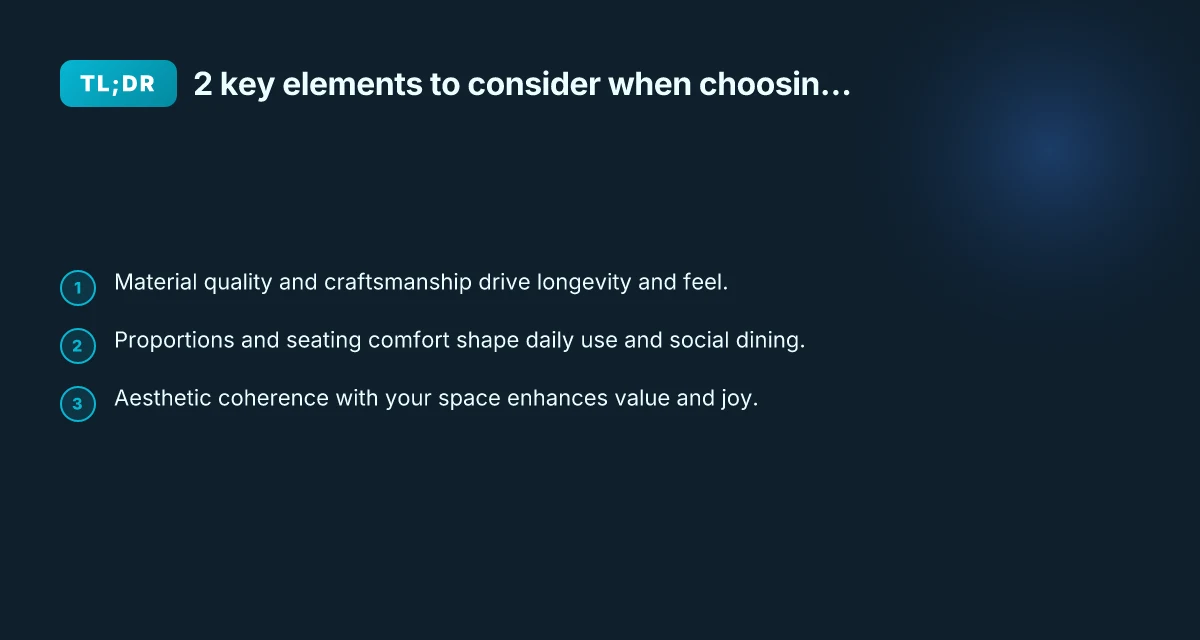
Choosing a luxury dining table set is as much about how it makes you feel as how it looks. The two key elements you should weigh first are material quality and craftsmanship, and the proportions and seating comfort the set offers. When you balance these factors, you’ll end up with a table and chairs that not only elevate your dining room’s aesthetic but also stand the test of daily use and special occasions.
Non-negotiables: Material quality & craftsmanship
| Aspect | Material quality | Craftsmanship | Durability | Warranty |
|---|---|---|---|---|
| Wood type | solid hardwood | hand-finished | high | 5–10 yrs |
| Veneer load | full veneer | precise assembly | durable | 5 yrs |
| Joinery | dowels/tenons | hand-fit | strong | 3–5 yrs |
| Finish | lacquer/oil | detailing | wear-resistant | 2–5 yrs |
| Hardware | solid metal | artisanal fittings | robust | 1–5 yrs |
| Origins | sustainable | artisan-made | reliable | disclosed |
Compiled November 2026; check the provider's site for current details.
The two non-negotiable elements: material quality and craftsmanship
Why material quality matters
- Longevity: premium woods, metals, and finishes resist wear and keep their luster.
- Tactile luxury: the feel of a well-finished surface communicates value and care.
- Maintenance realities: some materials resist stains or scratches better than others.
Craftsmanship as the differentiator
- Joinery and stability: dovetail, mortise-and-tenon, or reinforced steel frames reduce wobble.
- Consistency: uniform gaps, smooth edges, and precise sizing reflect attention to detail.
- Finishing touches: veneers, inlays, and hand-applied stains demonstrate refinement.
What to look for in practice
- Inspect under light: look for fine gaps and even finish.
- Ask about sourcing: traceability of wood, sustainable finishes, and allergen-free coatings.
- Request care guides: topcoats, cleaning routines, and refinishing options.

Proportions and seating comfort: the second pillar
Size and shape considerations
- Table length and width: ensure there’s at least 36 inches of clearance around for comfortable dining.
- Shape impact: rectangular tables suit long rooms. Round tables foster conversation. Oval blends the two.
- Height standard: 28 to 30 inches is typical. Consider leg design that doesn’t trap ankles.
Seating ergonomics
- Seat height vs. table height: standard chairs are about 18 inches from floor. Ensure a 10–12 inch knee clearance.
- Seat depth and padding: deeper seats support longer meals. Firmness affects posture after hours.
- Armrests and back support: consider your guests’ comfort, especially for longer dinners.
Practical steps to test comfort
- Sit at the table for a simulated meal: check reach to the center and to the edge.
- Check for leg room: ensure your knees don’t hit chair legs.
- Try table load: imagine serving dishes and multiple diners to gauge stability and comfort.
Material options: match luxury with lifestyle
Common luxury materials
- Solid wood: charismatic grain, durability, and repairability.
- Marble and natural stone: dramatic presence but requires maintenance and sealing.
- Metal accents: add modernity and resilience. Watch for weight and edge treatment.
- Lacquered or high-gloss finishes: sleek but susceptible to scratches or fingerprints.
Finishes and maintenance
- Protective coatings: polyurethane and varnish layers can reduce wear, but re-finishing may be needed over time.
- Heat resistance: stone and metal tolerate hot dishes better than untreated wood.
- Cleaning routines: some finishes tolerate damp cloths. Others require polish-safe products.
Choosing for lifestyle
- Busy households: prioritize scratch resistance and simple maintenance.
- Entertainers: favor larger leaves, sturdy extensions, and elegant, easy-care surfaces.
- Pet owners: look for durability and scratch-resistant finishes.
Proportions & seating comfort: the second pillar
| Aspect | Seat count | Table height (in) | Leg clearance (in) | Comfort note | Expansion | Surface area |
|---|---|---|---|---|---|---|
| 6–8 seat | 6–8 | 29–30 | 24 | balanced | leaf option | ample |
| 8–10 seat | 8–10 | 29–30 | 24 | comfortable | expandable | generous |
| 10–12 seat | 10–12 | 30 | 24 | spacious | add-on | large |
| Edge style | round/rect | flush or bevel | leg visibility | ergonomic | — | flatter |
| Seat width | 18–22 per | — | — | roomy | — | good |
| Guest comfort | cushion depth | armchair option | seating | intuitive | — | measured |
Compiled November 2026; check the provider's site for current details.
Table design: a quick comparison to guide your choice
| Material / Finish | Pros | Cons | Best use case |
|---|---|---|---|
| Solid hardwood (oak, walnut) | Rich character, repairable, timeless | Heavy, can swell with humidity, pricey | Everyday luxury with longevity |
| Marble top | Striking centerpiece, cool surface for serving | Porous or susceptible to staining, requires care | Formal dining rooms, occasional-use luxury |
| Metal frame with wood top | Sleek look, strong, lightweight options | Weight distribution matters, edge protection needed | Modern spaces, high-traffic rooms |
| Lacquered wood or glass top | Very contemporary, easy to wipe | Scratches show, fingerprints common | Contemporary apartments and showpiece sets |
| Stone-tiber top with protective seal | Durable, unique texture | Expensive, repair can be tricky | High-end dining rooms with showpieces |
The setting: how the table set fits your space
Room scale and visual balance
- Proportion to room: a large table can dominate a small room. A small table can feel insubstantial in a grand space.
- Rug and floor interactions: ensure chairs clear a rug edge and don’t snag.
- Wall art and lighting: the table should complement lighting fixtures and artwork without competing.
Lighting considerations
- Overhead lighting: a chandelier or pendant should fall within 24–36 inches of the tabletop to create ambiance without glare.
- Natural light: wood tones can shift with daylight. Consider finishes that hold color across light conditions.
- Task lighting: in formal spaces, consider subtle wall sconces to highlight the table’s finish.
Room acoustics
- Hard surfaces amplify noise. Consider a runner or rug under the dining area to soften sound.
- Chair design can affect sound: bolder or more cushioned chairs dampen echoes.
Material options: match luxury with lifestyle
| Material | Look & feel | Maintenance | Scratch resistance | Vegan-friendly | Price tier | Best for |
|---|---|---|---|---|---|---|
| Solid walnut | warm, rich | moderate | high | yes | mid–high | classic elegance |
| Oak | light to mid | easy | moderate | yes | mid | versatile spaces |
| Mahogany | deep red | careful | high | yes | high | traditional luxury |
| Sapele | golden-brown | moderate | good | yes | mid | contemporary style |
| Marble inlay | dramatic | high | low | no | high | showpiece sets |
| Metal accents | modern | low | high | yes | mid | urban luxe |
Compiled November 2026; check the provider's site for current details. Signs you need a new mattress right now
How to verify authenticity and value before you buy
Documentation to request
- Material certificates: proof of wood origin, sustainable forestry, or stone provenance.
- Warranty and service policy: coverage on table surface, joints, and mechanisms for extensions.
- Care and refinishing guidance: official maintenance schedules and product-specific recommendations.
How to inspect in person
- Check the weight: heavier often signals solid construction and quality materials.
- Examine the edges: hand-finished edges feel smooth. Machine edges may appear uniform but lack refinement.
- Test stability: place pressure on corners and test leaf extensions for smooth operation.
The trade-off framework
- Investment vs. use frequency: if you dine daily with many guests, prioritize longevity over ultra-light forms.
- Custom vs. off-the-shelf: customization can guarantee fit and unique character but adds lead time and cost.
- Resale value: renowned brands or timeless designs can retain value and even appreciate.
Final section: practical recommendation If you’re choosing a luxury dining table set, start with the two core elements: material quality and craftsmanship, and the proportions and seating comfort. In most homes, a solid hardwood table with a carefully engineered joinery system offers enduring beauty and reliability. Pair it with chairs that provide substantial back support, appropriate padding, and a comfortable seat height relative to the table. A shape that suits your room, rectangular for longer rooms or round for intimate gatherings, will influence not only aesthetics but everyday use.
For a balanced purchase, choose finishes and materials that align with your lifestyle. If you host frequently and value longevity, select a finish with robust scratch resistance and a finish that’s easier to maintain. If your space leans modern, a metal-framed base with a wood or stone top can offer the luxury you want without overpowering the room. Finally, ensure you have a clear plan for space planning, including extension leaves, clearance around the table, and rug placement, so the set feels integrated rather than imposed.
Bottom line: the best luxury dining table set harmonizes exceptional material quality and craftsmanship with thoughtful proportions and seating comfort. When these two elements are aligned, the result is a dining experience that feels both lavish and livable, day after day, meal after meal.