Signs you need a new mattress right now
Learn the clear signs you need a new mattress today, plus practical tips to choose a better replacement.
If you’ve been waking up sore, tangled in sheets, or feeling more restless than you did years ago, it might be time to consider a new mattress. Not every twitch or ache means you need a replacement, but several clear signs suggest your bed is no longer supporting your body the way it should. Below is a practical guide to tell-tale indicators and what to do next.
Common physical signs you need a new mattress — quick checks
| Sign | How it feels | Frequency noticed | Action if present | Priority (1-5) |
|---|---|---|---|---|
| Sinking in | Soft, uneven support | Often | Consider replacement | 4 |
| Sagging | Visible indentations | Occurs over time | Inspect age; replace | 3 |
| Firmness loss | Worn comfort | Regular | Test with trial | 3 |
| Back/neck pain | Stiff upon rising | Frequent | Evaluate mattress age | 4 |
| Noise | Creaks or squeaks | Occasional | Check springs | 2 |
| Pressure points | Numb/tingle | After sleep | Assess layering | 3 |
Compiled November 2026; check the provider's site for current details.
Common physical signs you need a new mattress
- Persistent morning pain: Back, neck, shoulders, or hips that hurt daily or the pain lasts well into the day.
- Worse sleep quality: Trouble falling asleep, frequent waking, or feeling unrested after a full night.
- Increased allergy or congestion: Dust, mold, or other allergens accumulating in a mattress can trigger symptoms.
- Uneven support: You notice you sink into the mattress in certain spots or your partner’s movement disrupts your sleep more than it used to.
- Posture changes: A new or worsening posture while sleeping, such as a curve in your spine or a stiff neck.
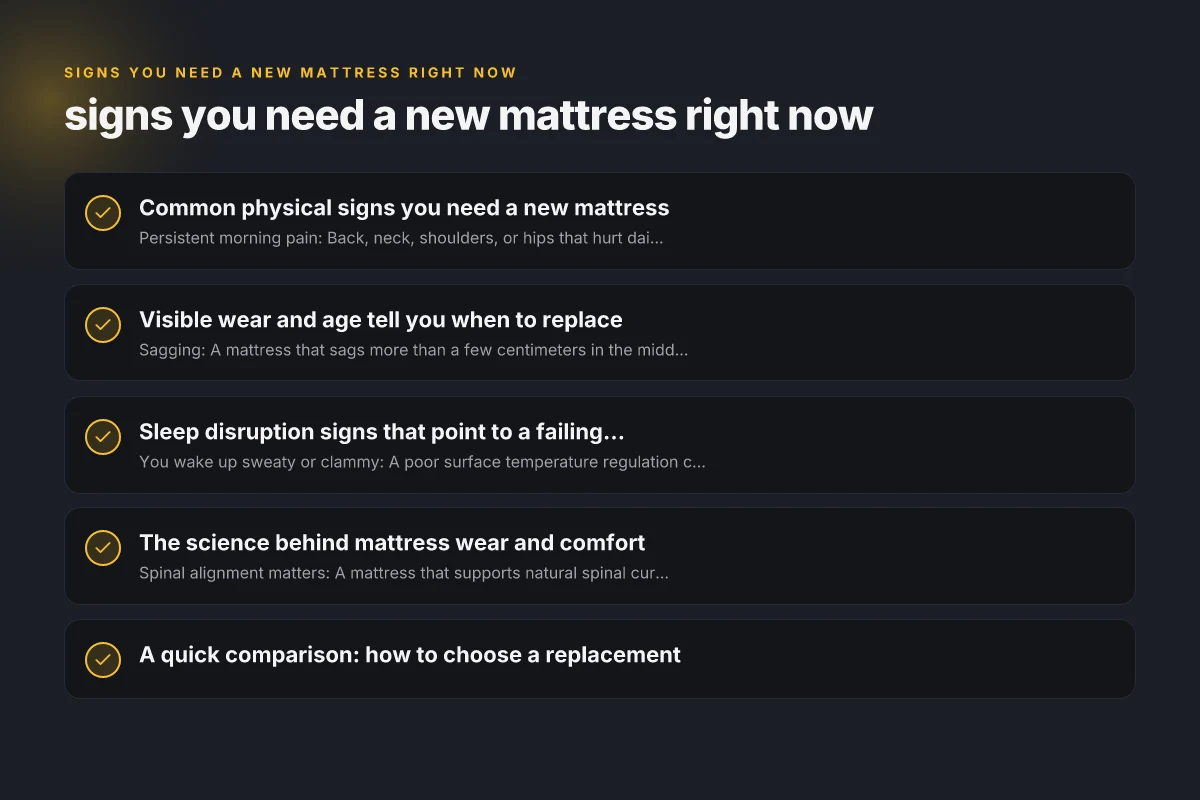
Visible wear and age tell you when to replace
- Sagging: A mattress that sags more than a few centimeters in the middle or near the edges.
- Lumps, sags, or indentations: Visual deformities that align with discomfort.
- Worn-out feel after a few years: If your mattress is aging past the 7–10 year mark for most spring or hybrid models, it’s likely losing supportive integrity.
- Noisy springs or creaks: Metal innersprings that groan or squeak indicate degraded support layers.
How long should a mattress last?
- Innerspring: typically 7–10 years.
- Memory foam: usually 8–10 years.
- Latex or hybrid: often 10–12 years, sometimes longer with good care.
- If you’re within 1–2 years of the upper end of these ranges and still unhappy, you may tolerate a replacement sooner in response to discomfort or changing needs.
Sleep disruption signs that point to a failing mattress
- You wake up sweaty or clammy: A poor surface temperature regulation can be a symptom of an old or poorly breathable mattress.
- You can’t fall asleep or stay asleep: This can be due to contouring, motion transfer, or discomfort that keeps you awake.
- Snoring or partner disruption increases: A mattress that doesn’t dampen movement can disturb your sleep partner and amplify sleep fragmentation.
- You wake with numbness or tingling: Poor pressure distribution or restricted circulation from a worn surface.
The science behind mattress wear and comfort
- Spinal alignment matters: A mattress that supports natural spinal curves reduces morning pain and fatigue.
- Pressure distribution: Good mattresses evenly distribute weight to avoid pressure points at shoulders, hips, and knees.
- Motion isolation: For couples, a mattress that minimizes partner movement reduces wake-ups.
How to assess your current mattress quickly
- Check for visible signs: Sagging, lumps, stains, and worn edges.
- Test core feel: Lie on your back, then your side. Note if the surface feels too soft or too hard in key areas.
- Note sleep quality changes: Record a week of sleep quality, morning pain, and mood.
- Look at age: If older than the typical life span for your mattress type, consider a replacement.
- Inspect for allergies: Signs of musty odors or increased nasal symptoms can indicate dust mites or mold.
Visible wear and age tell you when to replace — quick visual/age cues
| Cue | What to look for | Typical lifespan | Best action | Replacement likelihood |
|---|---|---|---|---|
| Sagging edges | Edges dip when sat on | 5-7 years | Test firmness | Moderate |
| Visible deformity | Lumps, craters | 6-10 years | Compare to new | Moderate-High |
| Fabric wear | Tears, thinning fabric | 5-8 years | Inspect for comfort | Low-Moderate |
| Coil squeak | Metallic sounds | 6-8 years | Consider replacement | Moderate-High |
| Wrapper fray | Bedding wear | 4-10 years | Evaluate overall | Variable |
| Age since purchase | >7-10 years | Usually replace | Plan upgrade | High |
Compiled November 2026; check the provider's site for current details.
A quick comparison: how to choose a replacement
| Factor | Budget options | Mid-range | Premium |
|---|---|---|---|
| Support | Medium, may sag faster | Solid support, good edge support | Targeted zoning, long-lasting materials |
| Comfort layer | Basic foam or fiber | Memory foam or latex blends | High-density latex, advanced foams |
| Motion isolation | Moderate | Good | Excellent, ideal for couples |
| Temperature regulation | Variable | Better with breathable covers | Superior cooling and moisture wicking |
| Durability | Shorter lifespan | Balanced durability | Long-lasting, often 10+ years |
| Price range | Low | Moderate | High |
Practical steps if you’re debating replacement
- Measure your bed frame: Ensure the new mattress fits your bed base and foundation.
- Try before you buy: If possible, test in-store or use a risk-free trial from online brands.
- Consider your sleeping position: Side sleepers often need softer to moderate support. Back and stomach sleepers may prefer firmer surfaces.
- Factor in partners: If you share your bed, look for low motion transfer and compatible firmness.
Your replacement plan
- Define budget: Decide how much you’re willing to spend for a longer lifespan and better comfort.
- Decide on type: Innerspring, memory foam, latex, or hybrid, each with pros and cons based on your needs.
- Choose a firmness level: If you’re unsure, start with a medium-firm option and adjust based on your comfort after a few weeks.
- Check warranties and return policies: A strong trial period and warranty protect your investment.
Sleep disruption signs that point to a failing mattress — disruption signals
| Sign | Description | Common cause | Mitigation | Replacement indicator |
|---|---|---|---|---|
| Tossing/turning | Frequent changes | Uneven support | Pad/rotate | Yes (persistent) |
| Morning stiffness | Back/neck pain | Poor alignment | Adjust firmness | Yes if recurring |
| Sleep latency up | Hard to fall asleep | Comfort issues | Trial different | Yes if persists |
| Reduced deep sleep | Less restorative | Discomfort | Try topper | Yes if unchanged |
| Partner disturbance | Movement transfer | Soft/poor support | Upgrades | Yes if ongoing |
| Sleep fragmentation | Frequent awakenings | Heat/pressure | Cooler setup | Yes if chronic |
Compiled November 2026; check the provider's site for current details. Sanctuary setup: create a peaceful bedroom scene with home wall décor
Signs you should consult a professional about sleep health
- Chronic pain that isn’t improving with a mattress change.
- Persistent sleep problems despite trying different mattresses.
- A sudden change in sleep patterns or fatigue that you can’t attribute to lifestyle factors.
How to decide between repair or replace
- If the frame or foundation is damaged, you may replace or repair the base rather than the mattress.
- If the top layer is degraded and you’re still within the mattress’s expected lifespan, you might consider a mattress topper for a temporary fix.
- A new mattress is usually more cost-effective than repeated top-ups for significant discomfort or instability.
The recommendation: start with a plan that fits your sleep
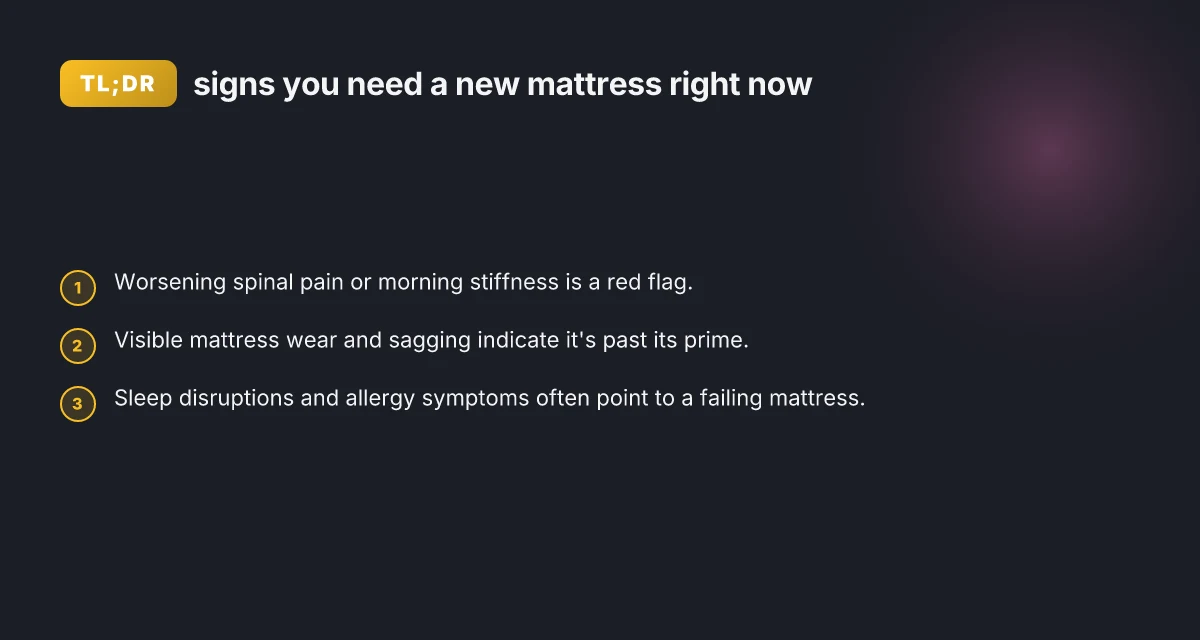
If you’re noticing multiple signs on this list, daily morning pain, visible sagging, frequent sleep disruptions, or allergen-related symptoms, it’s a strong indicator that you need a new mattress now. The right replacement can restore proper spinal alignment, improve sleep quality, and reduce allergy symptoms. Start with a clear budget, assess your preferred materials and firmness, and consider a risk-free trial to ensure you don’t waste money on something that won’t meet your needs.
Final recommendation: prioritize a mattress that offers solid support for your dominant sleeping position, targeted pressure relief in hips and shoulders, good edge support if you share the bed, and minimal motion transfer if you sleep with a partner. Use the facts above to guide your shopping and aim for a product that comes with a generous trial period and a robust warranty. Your sleep, and your body, will thank you.