
Vintage bathroom accessories detail
A practical guide to understanding, sourcing, and styling vintage bathroom accessories with care.
Vintage bathroom accessories detail
A bathroom dressed in vintage accessories can feel like a tiny time capsule. From chrome soap dishes to enamel-topped trays, these pieces bring character, texture, and a story to your space. This guide explains what makes vintage bathroom accessories special, how to identify quality, how to restore or repurpose what you already own, and how to style them for a cohesive look.
Quick criteria for evaluating vintage bathroom accessories
| Item | Era/Style | Material | Condition | Rarity | Value potential |
|---|---|---|---|---|---|
| Pedestal sink faucet | Victorian / Art Deco | Brass | Worn / patina | Rare | Moderate-High |
| Glass apothecary jar | 1920s–1950s | Glass | Clear, no cracks | Common | Low-Moderate |
| Towel bar | Mid-century | Chrome / Nickel | Scratches, chrome wear | Common | Low-Moderate |
| Ceramic soap dish | Flow blue / Transferware | Ceramic | Chip or glaze crack | Uncommon | Moderate |
| Mirror with beveled edge | Early 20th c. | Glass / Metal | Mirror haze sometimes | Rare | Moderate-High |
| Toothbrush holder | 1950s | Ceramic / Porcelain | Chips ok if intact | Common | Low-Moderate |
| Linen cabinet latch | Art Deco | Brass | Good patina | Uncommon | Moderate-High |
| Porcelain soap pump | 1930s–1960s | Porcelain | Crackle glaze ok | Moderate | Moderate-High |
Compiled November 2026; check the provider's site for current details.
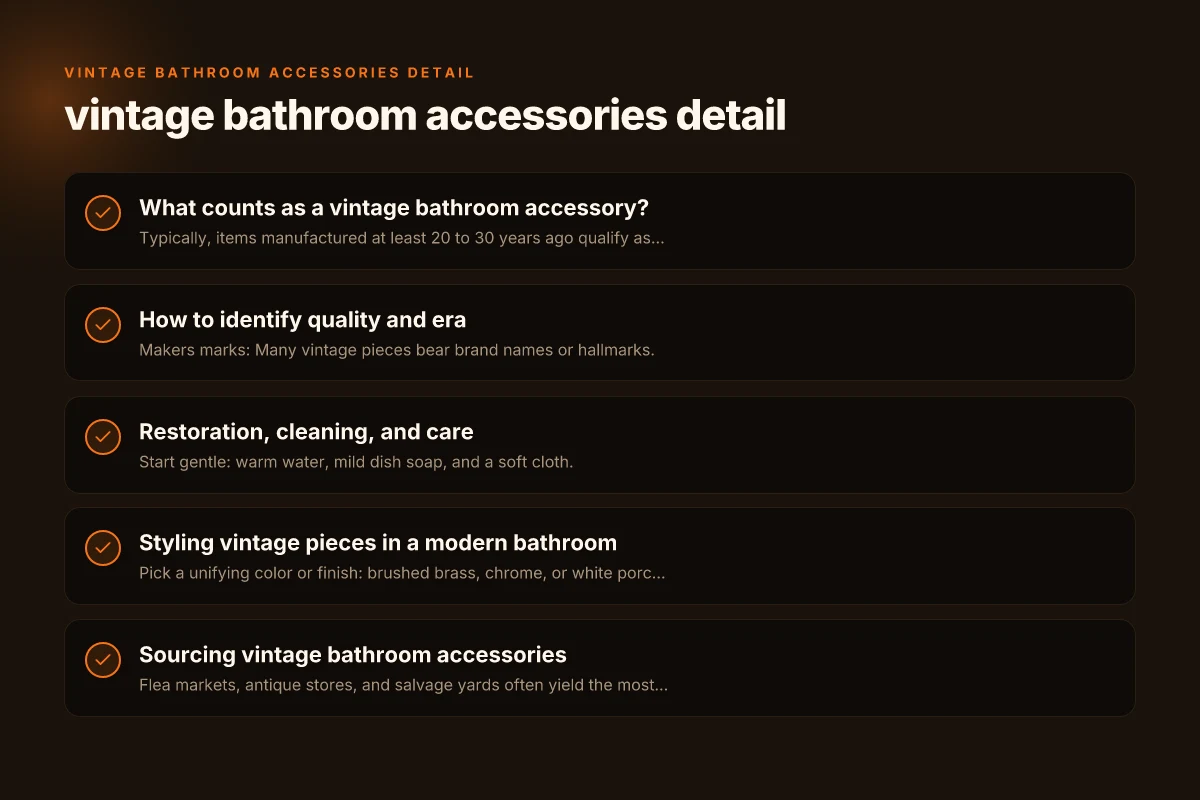
What counts as a vintage bathroom accessory?
Defining vintage in the bathroom
- Typically, items manufactured at least 20 to 30 years ago qualify as “vintage,” though tastes vary.
- Common categories include hardware (towel bars, robe hooks, toilet paper holders), vanity hardware (knobs, handles), containers (soap dishes, toothbrush holders), glassware (perfume bottles, dispensers), and mirror or cabinet hardware.
Typical materials and finishes
- Metals: brass, nickel, chrome, copper, often with patina or lacquered finishes.
- Porcelain and enamel: white or colored glazes with crisp edges.
- Glass: pressed patterns, hobnail, or hand-blown shapes.
- Bakelite and early plastics: warm resin tones used in mid-century designs.
How to identify quality and era
Clues to look for
- Makers marks: Many vintage pieces bear brand names or hallmarks.
- Construction details: Solid mounting, sturdy screw hardware, and durable snaps or clasps.
- Wear patterns: Uniform patina can indicate age. Uneven wear may reveal later rewrites or replacements.
- Glass and enamel: Clear, intact enamel chips remove value. Some patina is expected on older finishes.
Common eras you might encounter
- 1920s–1930s: Art Deco influences, geometric shapes, delicate porcelain, flip-top or push-button dispensers.
- 1940s–1950s: Streamlined chrome, bakelite handles, rounded forms, sturdy enamel frames.
- 1960s–1970s: Bold colors, plastic or resin bodies, playful shapes, and mass-market production.
- 1980s–1990s: Revival styles, chrome with higher gloss, and occasionally plastic faux-wood accents.
How to compare pieces by era and maker
| Criterion | Description | How to verify | Typical markers | Notes |
|---|---|---|---|---|
| Era indicators | Style cues, shapes | Examine silhouette | Art Deco, Mid-century, Victorian | Cross-check with catalogs |
| Maker marks | Brand or signature | Look on back/base | S.211, R. M. Co. etc. | Often faint |
| Construction | Joining methods | Check seams, screws | Brass fittings, lead-free glaze | Quality hint |
| Patina & wear | Age-related wear | Surface patina | Uniform wear vs. repairs | Patina valued by collectors |
| Glass & ceramic quality | Glaze, clarity | Inspect glaze, thickness | Crystal clear, sculpted relief | Higher quality = higher value |
| Condition flags | Repairs or cracks | Look for cracks, chips | Restorable vs. compromised | Affects price heavily |
| Rarity signals | Limited runs or brands | Production counts | Limited editions | Impacts resale value |
| Provenance | Documentation | Original receipt, tags | Museum labels | Adds value |
Compiled November 2026; check the provider's site for current details.
Restoration, cleaning, and care
Cleaning without damage
- Start gentle: warm water, mild dish soap, and a soft cloth.
- For metal: avoid abrasive pads. Use a non-abrasive polish following manufacturer directions. For brass or bronze, a mild lemon-oil or specialized metal polish can restore glow.
- For enamel and porcelain: use a soft brush for crevices and non-acid cleaners to avoid scratching.
- Glass and crystal: wipe with a microfiber cloth. For stubborn buildup, soak briefly in warm water with a touch of dish soap.
When to repair or replace
- Structural damage: cracked porcelain, loose mounting, or cracked glass typically requires professional repair or replacement.
- Patina vs. corrosion: a light patina adds character. Active corrosion may compromise safety and function.
- Seals and hoses: old gaskets or hoses should be replaced for hygiene and safety reasons.
Simple DIY improvements
- Refinish hardware: If chrome is dull, chrome polish can revive shine. If tarnished, consider a light repaint or replating by a professional.
- Replace grips or knobs: Swap worn knobs for period-correct alternatives to refresh a vanity or cabinet.
- Stabilize loose fixtures: Tighten mounting hardware and use appropriate wall anchors for heavier pieces.
Styling vintage pieces in a modern bathroom
Create a cohesive look
- Pick a unifying color or finish: brushed brass, chrome, or white porcelain can anchor diverse pieces.
- Mix, don’t match: Combine two or three era-appropriate finishes for depth, but keep a consistent scale and balance.
- Use negative space: Allow vintage pieces to stand out with clean countertops and minimal clutter.
Practical layout ideas
- Layered vanity: Place a vintage soap dish and matching toothbrush holder on either side of a modern faucet to blend eras.
- Shower and storage: Integrate enamel or glass containers on open shelves to echo vintage aesthetics without interrupting function.
- Mirror pairing: Choose a vintage frame or hardware to complement the mirror rather than the entire vanity.
Color and material guidelines
- Warm metals (brass, aged bronze) pair well with creamy whites, soft beiges, and slate.
- Chrome or nickel contrasts suit cooler tones like gray, navy, and black.
- Glass pieces add light and reflection. Choose clear or lightly frosted options to keep space feeling open.
Sourcing vintage bathroom accessories
Where to look
- Flea markets, antique stores, and salvage yards often yield the most character-filled pieces.
- Online marketplaces: search with specific terms like “vintage porcelain soap dish,” “1930s bathroom hardware,” or “mid-century bathroom accessory.”
- Reuse centers and architectural salvage shops can have hidden gems like brass towel bars or enamel trays.
How to evaluate value
- Condition: minimal chips, no cracks, intact mounting hardware.
- Provenance: maker marks, original packaging, or documented history add value.
- Rarity: unusual shapes, limited editions, or designer collaborations are typically more sought after.
- Functionality: ensure items still perform their intended purpose (e.g., dispensers still dispense, holders hold securely).
Budget-friendly tips
- Prioritize essentials: a single standout piece (a brass towel bar or a glass dispenser) can anchor the space.
- Combine new and vintage: use one or two vintage accents with new basics for balance.
- DIY refresh: with careful cleaning and light restoration, many mid-century chrome pieces can look fresh again.
A quick comparison table: classic vintage bathroom accessories
| Item category | Typical era | Material/finish | What to look for | Maintenance needs |
|---|---|---|---|---|
| Soap dish | 1920s–1970s | Porcelain, ceramic, or enamel | Chips, glaze wear, secure mounting | Gentle cleaning; avoid alkaline cleaners on enamel |
| Towel bar | 1940s–1970s | Chrome, brass, or nickel | Straight bars, no bends, mounts solid | Regular wipe-down; polish to reduce tarnish |
| Toothbrush holder | 1950s–1970s | Ceramic or glass | Unbroken lip/edge; stable base | Gentle glass cleaning; avoid dishwasher for porcelain |
| Lotion/soap dispenser | 1960s–1980s | Glass with metal or plastic pump | Leaks, pump function, lid seal | Replace pumps if stiff; hand wash only |
| Vanity hardware | 1930s–1970s | Brass, chrome, or painted metal | Secure screws, match with other hardware | Tighten screws; avoid over-tightening |
Care and restoration decision guide for vintage bath pieces
| Item type | Cleaning approach | Repairs feasible | Materials to avoid | Signals restoration needed | Risk level (low/med/high) |
|---|---|---|---|---|---|
| Brass fittings | Mild soap, wax polish | Replating possible | Harsh acids | Severe corrosion | Medium-High |
| Chrome towel bar | Gentle cleaner, microfiber | Re-chrome possible | Steel wool | Pitted chrome | Medium |
| Glass apothecary jar | Warm water, mild detergent | Reattach lid, replace seal | Ammonia on decals | Cracked glass | High |
| Porcelain soap dish | Soft cloth, non-abrasive | Re-glaze or replace | Alcohol-based cleaners | Hairline cracks | Medium-High |
| Ceramic toothbrush holder | Toothbrush-friendly cleaner | Reattach broken piece, glaze touch-up | Solvents | Chips/separation | Medium |
| Beveled mirror frame | Glass cleaner, microfiber | Frame stabilization | Ammonia near silvering | Frame rot | High |
Compiled November 2026; check the provider's site for current details. Vintage bathroom accessories decor: how to embrace timeless charm in your space
Final thoughts and practical recommendation
Vintage bathroom accessories can elevate a space with storytelling, texture, and a sense of history. The best approach is to curate a few standout pieces that speak to your style, then blend them with modern essentials to maintain usability and cleanliness. Start with one focal piece, perhaps a visually striking brass towel bar or a porcelain soap dish, and build around it with complementary items in similar tones or finishes. If you’re unsure where to begin, consider a small set of coordinated pieces from the same era or manufacturer. This makes it easier to achieve a cohesive look without feeling cluttered.
A practical plan:
- Inventory what you already have: identify pieces that could be restored and paired with new basics.
- Decide on a unifying finish: choose two to three finishes (e.g., chrome, brass, white porcelain) that you’ll reuse across pieces.
- Go in stages: acquire one or two reliable vintage pieces first, test the look, then add more as you fall into a rhythm.
- Prioritize hygiene: ensure items are easy to clean and free from cracks or leakage, especially in damp environments.
- Preserve and protect: avoid over-polishing to maintain natural patina where appropriate. Consider sealants on porous surfaces when recommended by professionals.
If you want a more tailored approach, tell me your bathroom size, existing fixtures, and budget. I can draft a sourcing list with specific vintage pieces, compatible modern items, and a layout plan designed to maximize charm while keeping practical daily use effortless.