Take note of these details when you buy a wall safe
A practical buyer’s guide highlighting essential details to consider when purchasing a wall safe.
Buying a wall safe is a smart move for protecting valuables, documents, and small electronics in a home or small office. But the market is full of options, and the wrong choice can lead to frustration or even compromised security. This guide walks you through the key details you should take note of before you buy a wall safe, so you end up with a model that fits your needs, space, and budget.
Security level and certifications
What level of protection do you need?
- Consider what you’re protecting (cash, jewelry, important documents, backups of digital data).
- If you’re protecting irreplaceable items, aim for a higher security rating and robust construction.
Common standards to look for
- UL ratings (United States) for wall safes and burglar resistance.
- EN 1143-1 or EN 1143-2 for European standards (graded safes).
- Sold secure ratings or independent lab certifications in your region.
What those ratings mean
- Burglary resistance: how quickly a safe resists forced entry.
- Drill resistance: protection against drilling attempts.
- Fire resistance: whether the safe can withstand heat without compromising contents.
When evaluating, compare the security features side by side. A safe with a longer testing duration, reinforced bolts, and high-grade steel is generally more durable.
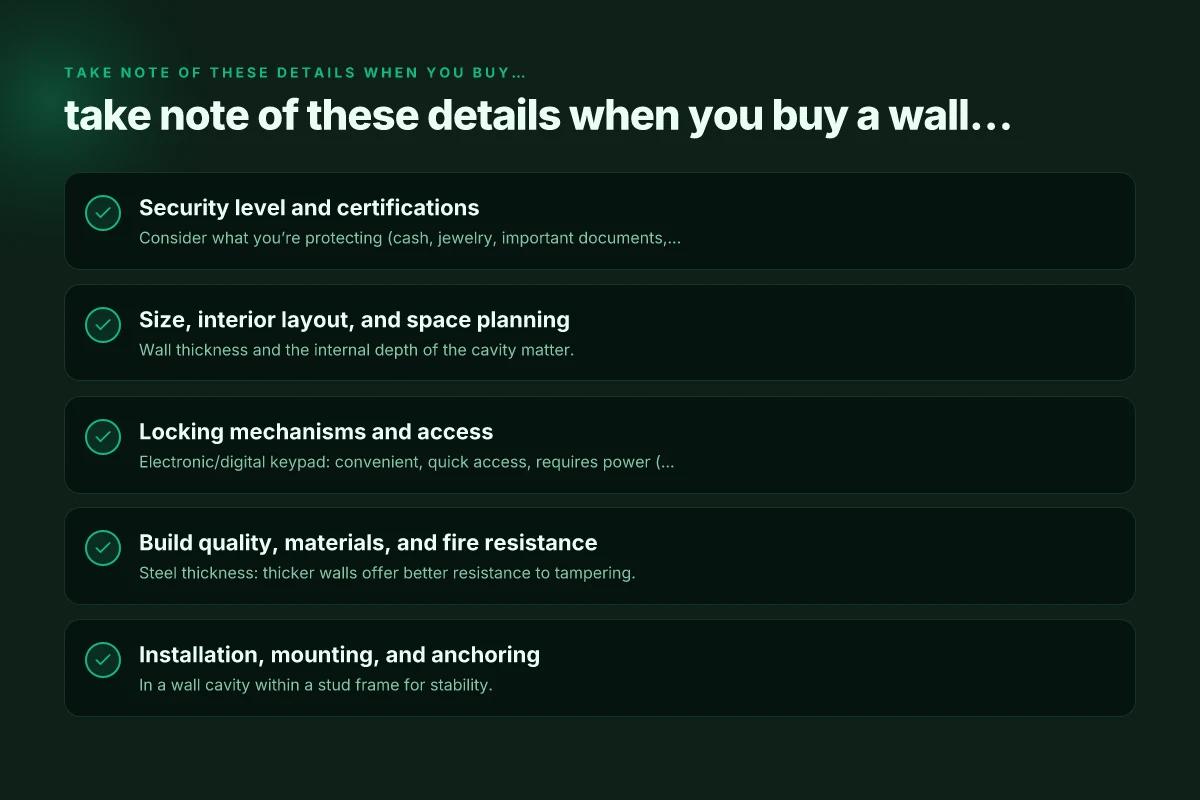
Size, interior layout, and space planning
Measuring your space
- Wall thickness and the internal depth of the cavity matter.
- Account for studs, wires, pipes, and the thickness of drywall or plaster.
- Leave room for the door to open fully, and ensure it doesn’t interfere with nearby wiring or fixtures.
Interior arrangement
- Shelf configuration: adjustable shelves help you optimize space.
- Pockets or pockets for small items: useful for coins, jewelry, or keys.
- A built-in magnet or hook system for light items can simplify management.
The table: typical interior layouts
| Model type | Interior depth | Adjustable shelves | Door swing | Ideal for |
|---|---|---|---|---|
| Compact wall safe | 6–8 inches | Some | 90 degrees | Passports, jewelry, small cash bundles |
| Medium wall safe | 8–12 inches | Yes | 90–110 degrees | Documents, small electronics, cash |
| Large wall safe | 12–16 inches | Yes | 90–110 degrees | Backups, passports with bulk coins, larger jewelry cases |
Hidden vs visible installation
- Hidden: recessed into wall with a cover plate. Less obvious but often more complex to install.
- Visible: may be mounted behind a cabinet pane or behind a fake outlet, easier to access but less discreet.
Locking mechanisms and access
Types of locks
- Electronic/digital keypad: convenient, quick access, requires power (battery life matters).
- Biometric fingerprint: convenient, can be highly resistant to theft if implemented well, but false rejections are a risk.
- Keyed: simple and reliable, but keys can be lost or stolen.
- Manual combination: old-school and reliable if you don’t want electronics, but less convenient.
Battery life and maintenance
- Electronic safes rely on batteries. Check expected battery life and how easy it is to replace.
- Some models provide low-battery alerts and external power options in emergencies.
- If you travel or power outages are a concern, choose a safe that maintains access with backup power or a stored override.
Access control considerations
- Number of user codes or fingerprints: consider how many trusted users you need to accommodate.
- Time-delay and audit features: some safes log access attempts, which helps with security audits.
- Override options: ensure you know how to open the safe if you forget codes or lose keys, ideally with a secure master override.
Build quality, materials, and fire resistance
Core materials
- Steel thickness: thicker walls offer better resistance to tampering.
- Door and hinge construction: robust hinges and reinforced doors add to durability.
- Finish and corrosion resistance: powder coating or stainless surfaces can withstand humidity.
Fire resistance ratings
- Look for fire protection ratings measured in minutes (e.g., 30, 60, 120 minutes).
- Fire ratings indicate how long the interior can stay below critical temperatures to protect documents and valuables.
- Note that fire resistance is not a guarantee against water ingress. Some fire-rated safes also offer fire-star-rated water resistance.
Construction quality cues
- Welds and seam quality: clean welds with no gaps indicate better craftsmanship.
- Bolts and locking bolts: multiple locking points and heavy-duty bolts deter prying.
- Doors with relocking devices: prevent forced entry if a bolt or lock is compromised.
Installation, mounting, and anchoring
Where to mount
- In a wall cavity within a stud frame for stability.
- In a closet or cabinet behind a discreet panel to keep it out of sight.
- In a home office or bedroom with ventilation considerations to avoid overheating.
How to anchor it properly
- Use the manufacturer’s anchoring kit and follow installation instructions precisely.
- Secure into studs or solid masonry with the provided hardware. Wall anchors alone are rarely enough.
- Ensure the safe is level. An angled install can cause doors to bind and locks to misalign.
Hidden electrical considerations
- If the safe uses an electronic lock, plan for battery changes without removing the safe from the wall.
- Some installations require power access through a dedicated conduit or conduit routing. Consult a licensed electrician if in doubt.
Maintenance, warranties, and after-sales support
Routine care
- Periodically test the lock operation without pushing it to the limit to ensure reliability.
- Replace batteries on a regular schedule, and keep spare batteries on hand.
- Keep the safe clean and dry. Excessive moisture can cause corrosion or internal condensation.
Warranties and service
- Look for at least a 1–2 year manufacturer warranty on lock mechanisms and body.
- Check whether after-sales support includes free locksmith or service calls if something malfunctions.
- Understand what voids the warranty, drilling, forced entry attempts, or improper installation can invalidate coverage.
Documentation and compliance
- Keep the user manual, warranty card, and serial number in a separate secure location.
- If you’re safeguarding sensitive documents, ensure you comply with any local regulations for document safekeeping and now where to store backup copies.
Quick comparison: features to prioritize when choosing a wall safe
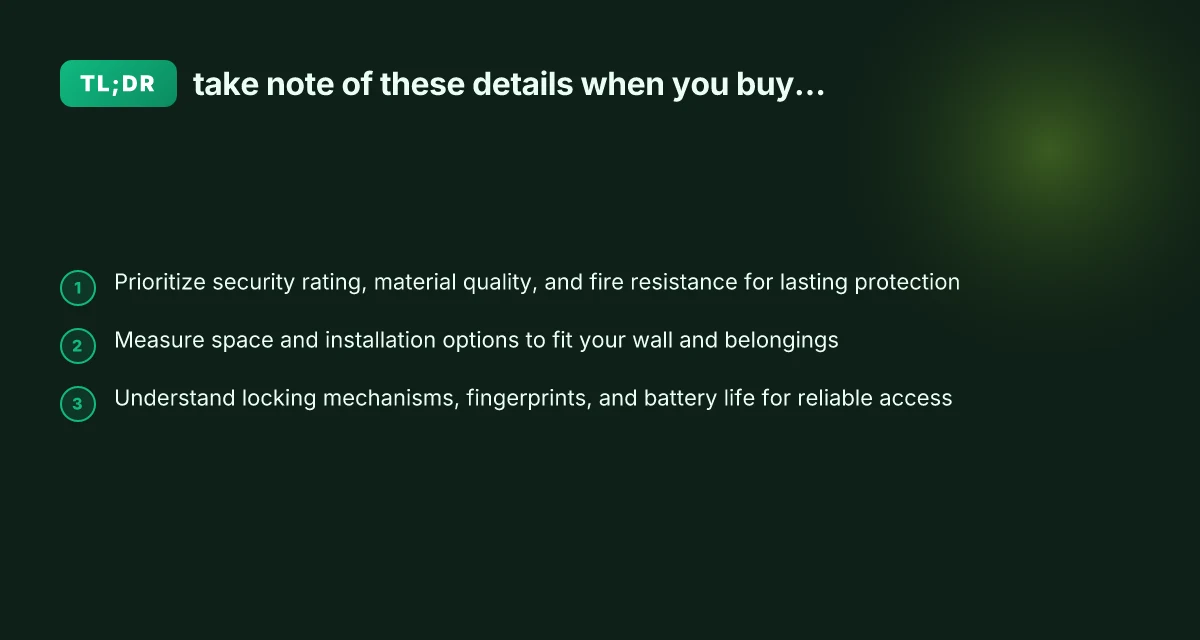
- Security vs. convenience: higher security often means longer installation time and potentially higher cost, but less risk of break-in.
- Fire rating vs. water resistance: decide which threat you’re prioritizing (fire vs. flood) and choose accordingly.
- Lock type: electronic vs. biometric vs. mechanical, depends on how fast you want access and your tolerance for maintenance.
- Size vs. wall space: larger safes offer more storage but require more space and proper anchoring.
- Warranty and service: a robust warranty reduces long-term risk and maintenance costs.
Here is a compact quick-check table to help you compare three common options:
| Safe type | Typical interior depth | Locking method | Fire rating | Best for |
|---|---|---|---|---|
| Wall Safe A | 8–10 inches | Electronic keypad | 30–60 minutes | General home use, documents, jewelry |
| Wall Safe B | 12–14 inches | Biometric + keypad | 60–120 minutes | Valuables, cash, backups, larger items |
| Wall Safe C | 6–9 inches | Mechanical/key | 30 minutes | Compact spaces, quick access, low tech |
Practical buying checklist
- Define what you’ll store: documents, jewelry, cash, digital media, backups.
- Set a budget range and compare models within it.
- Measure the space where the safe will go, including door clearance and cavity depth.
- Check security certifications and fire resistance ratings.
- Decide on the lock type and assess battery life or override options.
- Inspect build quality: material thickness, hinges, bolts, and finish.
- Review installation requirements and whether professional installation is advisable.
- Confirm warranty, service terms, and availability of spare parts.
- Plan for maintenance: battery changes, inspections, and periodic testing.
What to ask a retailer or installer
- Do you offer a professional installation service, and does it include anchoring to studs or masonry?
- Can you provide documented fire and security ratings from independent labs?
- What is the process for override access if codes are forgotten or keys are lost?
- Is the safe compatible with smart home or security systems, if you plan to integrate?
Final recommendation
If you want a balance of security, accessibility, and space efficiency, choose a wall safe with a robust metal construction, a proven burglary rating, and a practical fire rating, paired with a reliable electronic or biometric lock. Prioritize a model that offers adjustable interior shelving, easy battery replacement, and a clear, accessible override option. For most households, a medium-depth wall safe with a 60-minute fire rating and a secure electronic lock offers solid protection without overcomplicating installation.
When you’re ready to buy, compare a few models that meet these criteria, read independent reviews focused on real-world use (especially door operation and lock reliability), and confirm installation support and warranty terms. With careful attention to the details outlined above, you’ll take note of these details when you buy a wall safe and end up with a choice that keeps your valuables secure for years to come. 5 Signs you should go to the mattress dealer for a new mattress