Myths about choosing memory foam mattresses
Debunking common myths about memory foam mattresses and revealing the truth behind comfort, durability, and safety.
Memory foam mattresses have become a staple in modern sleep bedding, praised for pressure relief and contouring comfort. But myths persist, leaving shoppers uncertain about what to expect. Below, we tackle the most persistent beliefs, separating fact from fiction so you can choose a memory foam mattress that truly fits your sleep needs.
Quick myth vs. reality comparison
| Myth | Reality | Key evidence | Notes |
|---|---|---|---|
| Memory foam is always hot | Often improves cooling with modern tech | yes / sometimes | Look for gel, open-cell, graphite, or ventilation |
| All memory foam mattresses are the same | They vary by density, layering, and profile | varied | Check density, depth, support cores |
| Memory foam sleeps hot no matter what | Many slept cooler with advanced foams | sometimes | Airflow, phase-change materials, ventilation matter |
| Memory foam is only for side sleepers | Suitable for many sleep positions | yes / sometimes | Consider firmness and contouring needs |
| All memory foam mattresses last forever | Durability varies by materials and construction | no / varies | Look at support core and warranty |
Compiled November 2026; check the provider's site for current details.
Myth 1: Memory foam is always hot and uncomfortable
- Reality: Traditional memory foam tended to retain heat, which could cause sleepers to feel warm. However, the marketplace has evolved.
- Practical truth: Many memory foam mattresses now incorporate cooling features such as gel-infused foams, graphite or copper infusions, open-cell structures, and moisture-wicking cover fabrics.
- What to look for:
- Open-cell or breathable foams that promote airflow.
- Comfort layers with gel, graphite, or other phase-change materials.
- Adequate ventilation in the mattress core and a breathable cover.
- Quick test: If a mattress advertises “cooling features” or lists explicit cooling technologies, it’s more likely to mitigate heat retention.
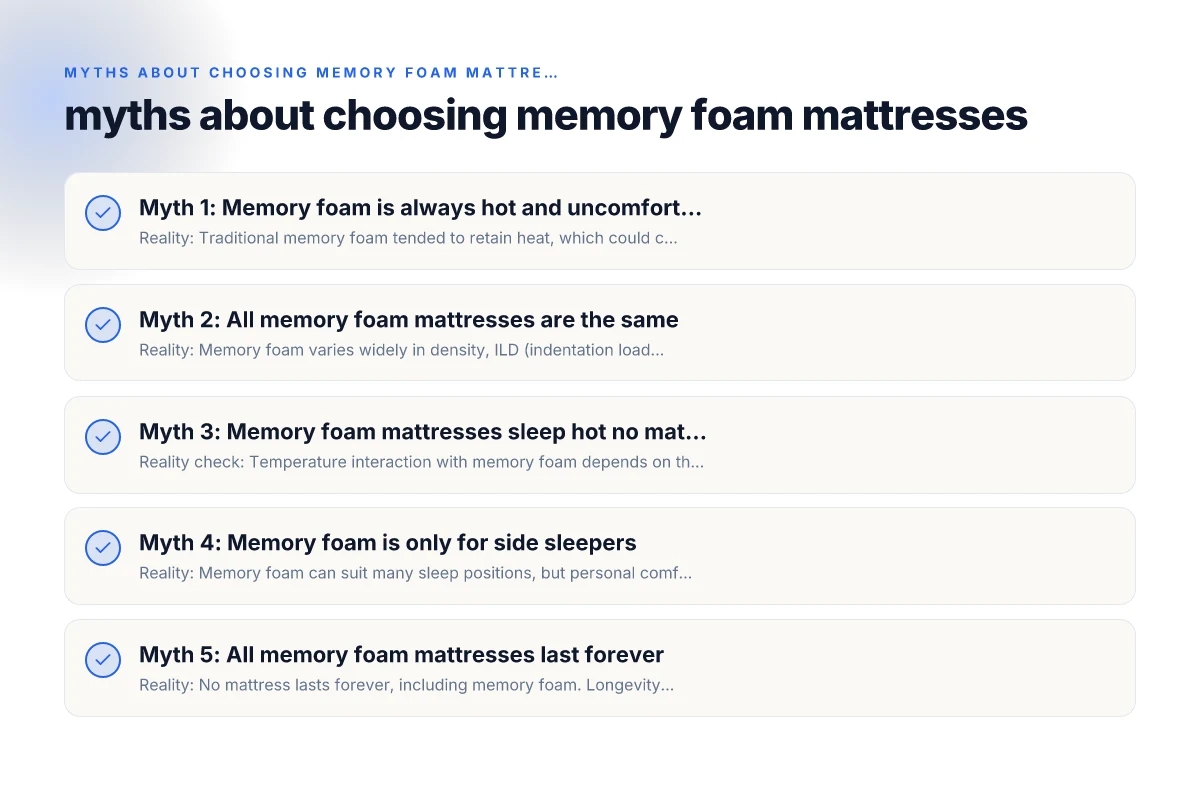
Myth 2: All memory foam mattresses are the same
- Reality: Memory foam varies widely in density, ILD (indentation load deflection), layering, and cover materials.
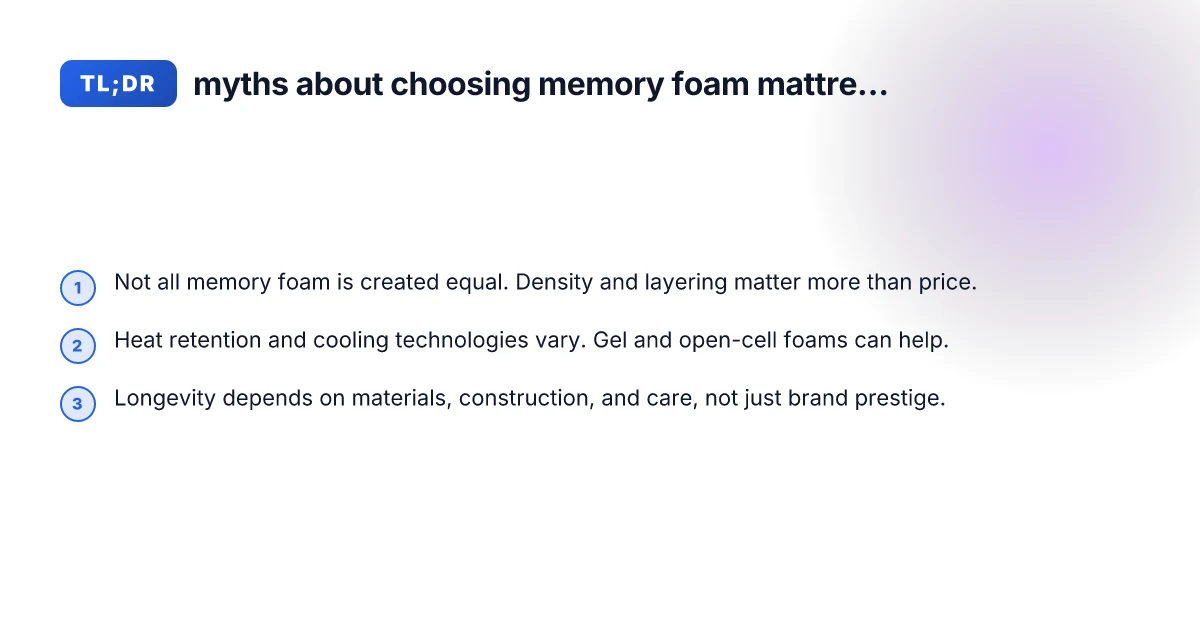
- Why density matters: Higher-density foams typically offer better years-long support and less sagging, but they can feel firmer. Lower-density foams may soften faster or wear down sooner.
- Layering strategy: A mattress might use a high-density support foam with a medium-density transition layer and a soft comfort layer. This affects contouring, pressure relief, and support.
- What to compare:
- Foam densities (core and comfort layers).
- ILD ratings for top layers.
- Layer order and thickness.
- Remove price as the sole predictor. Read specs and trial terms.
Myth 3: Memory foam mattresses sleep hot no matter what
- Reality check: Temperature interaction with memory foam depends on the whole system, not just the foam.
- Key factors:
- Layer composition: Thicker comfort layers can trap more heat if not ventilated.
- Mattress firmness: Pressured zones can influence airflow near the body.
- Foundation and room environment: A solid foundation with proper airflow and ambient room cooling can impact perceived temperature.
- Solutions:
- Look for a breathable cover (cotton or moisture-wicking blends) and a design that prioritizes airflow.
- Consider a model that emphasizes cooling layers and a well-ventilated core.
- Pair mattress shopping with room cooling strategies like a fan or AC and breathable sheets.
Myth 4: Memory foam is only for side sleepers
- Reality: Memory foam can suit many sleep positions, but personal comfort is the deciding factor.
- Why it’s appealing to many sleepers:
- Excellent pressure relief for hips, shoulders, and joints.
- Contour while maintaining spinal alignment when the layer structure is appropriate.
- Who benefits most:
- Side sleepers seeking pressure relief without sacrificing support.
- People with joint sensitivity who want even weight distribution.
- Those who appreciate a “cocooning” feel without excessive bounce.
- Important caveat:
- If you sleep on your back or stomach, you may prefer a slightly firmer feel or a mattress with more pronounced support to avoid lower back strain.
Myth 5: All memory foam mattresses last forever
- Reality: No mattress lasts forever, including memory foam. Longevity depends on materials, construction, and care.
- What affects lifespan:
- Foam density and quality: Higher density often correlates with slower breakdown.
- Layer design and how the mattress is used (bed frame, foundation, and rotation).
- Weight distribution: Heavier sleepers may experience faster wear in certain zones.
- Care tips to extend life:
- Use a proper foundation or bed frame with adequate support.
- Rotate the mattress 3–6 months if the manufacturer recommends. This helps distribute wear.
- Use a protector and avoid placing heavy objects on the mattress.
- Expected range: Many memory foam mattresses offer 7–10+ years of performance, with premium models edging toward the higher end. Factoring in warranty terms helps set realistic expectations.
Myth 6: Memory foam is unsafe or off-gassing is inevitable
- Truth: Modern memory foam products are designed to be low in volatile organic compounds (VOCs) and meet stricter safety standards.
- Off-gassing reality: Some initial odor may occur when unpacked, especially for dense foam or older formulations. This usually dissipates within a few hours to a few days in a well-ventilated room.
- Safety cues:
- Look for CertiPUR-US or Oeko-Tex certifications, which indicate materials meet certain low-VOC criteria.
- Read the label for emissions information and test results.
- Practical steps:
- Unbox in a ventilated space and allow the mattress to air out before placing sheets.
- If you’re sensitive to smells, consider models with explicit low-VOC claims and certifications.
Feature-driven decision table for memory foam mattresses
| Feature | High priority for you | Typical ranges / indicators | Practical tip | Example indicator |
|---|---|---|---|---|
| Density (ILD) | choose based on support | 3-5 lb/ft³ (low) to 5-6.5 lb/ft³ (high) | higher density = more support | 6 lb/ft³ often strong |
| Mattress depth | desired overall height | 8-12 in vs 12-14 in | deeper for heavier folks | 10-12 in common |
| Cooling tech | important | gel, open-cell, graphite | prioritize with hot sleep | gel-infused core |
| Off-gassing risk | low priority | varies by chemical treatment | air out before use | short initial odor |
| Motion isolation | important for sleepers | medium to high | look for dense foam layers | high memory foam proportion |
| Warranty length | important | 10-25 years | longer often better | 15+ years common |
Compiled November 2026; check the provider's site for current details.
Myth 7: The price is the best predictor of quality
- Reality: Price correlates with materials, warranty terms, and brand marketing, but it isn’t a universal measure of comfort or longevity.
- What to assess beyond price:
- Core construction: Are there reinforced edges? What is the zoning or support system?
- Layer composition: What densities and materials are used where?
- Trial period and warranty: A longer trial and a solid warranty often indicate confidence in durability and customer satisfaction.
- How to shop smart:
- Compare similar density and layer configurations across brands rather than chasing the lowest price.
- Read independent reviews focusing on long-term comfort and support.
- Check return policies and restocking fees.
A quick comparison guide: memory foam mattress features to watch
| Feature | What it means for you | What to look for in specs |
|---|---|---|
| Foam density | Higher density = better support and longevity | Look for core and comfort layer densities 20+ lbs/ft3 for core, 4–6+ lb/ft3 for comfort layers (varies by brand) |
| ILD (firmness) | How firm or soft the top feels | Transparent ILD ranges; try to find data on the exact layer you’ll contact most |
| Cooling technology | Reduces heat retention and promotes airflow | Gel, graphite, copper infusions; open-cell structure; breathable cover |
| Edge support | How well the mattress holds shape at the sides | Noticeable support around perimeter; look for reinforced edges |
| Certifications | Indicates safety and emissions control | CertiPUR-US, GREENGUARD Gold, OEKO-TEX, etc. |
| Trial period and warranty | Confidence in product performance and protection | 90–120 day trials; 10–20 year warranties common for premium products |
How to choose the right memory foam mattress for you
- Start with your sleeping position and comfort preference. Side sleepers often prefer a softer feel to maximize pressure relief, while back sleepers might opt for a medium feel with solid support.
- Consider your weight and how it interacts with the foam. Heavier sleepers may benefit from higher-density foams to minimize sagging.
- Prioritize a layered approach. A well-designed mattress uses a supportive core, a transitional layer to prevent sinking, and a top comfort layer that matches your preferred feel.
- Test and compare in person when possible. If you’re shopping online, take advantage of generous trial periods to make sure the mattress performs in your bedroom environment.
- Read warranties carefully. A robust warranty indicates the brand’s willingness to stand behind its product for years.
Short guide to care and maintenance
- Rotate or flip if the model allows it, following the manufacturer’s guidance.
- Use a breathable, washable cover to protect the surface and improve airflow.
- Keep the sleeping environment cool and dry. Avoid placing the mattress in direct sun or near heat sources.
- Vacuum your mattress surface occasionally to remove dust and allergens.
- If you notice persistent sagging or uneven support, consult the warranty terms and consider a professional assessment or replacement.
Side-by-side quick comparison guide (myth-busting)
| Criterion | Myth claim translation | What to verify | Quick verdict | How it affects choice |
|---|---|---|---|---|
| Heat | hot always | cooling features | often mitigated | choose breathable designs |
| Uniformity | same mattress | brand specs differ | not the same | compare density and layers |
| Longevity | lasts forever | warranties vary | not guaranteed | pick extended warranty |
| Safety/off-gassing | inevitable | material certifications | often low risk | look for CertiPUR-US / OEKO-TEX |
Compiled November 2026; check the provider's site for current details. Benefits of having a lectern
Final recommendation
If you’re choosing a memory foam mattress, start by identifying your priority features: cooling, density-driven support, or a balance of contour and firmness. Look for models with transparent specifications (density, ILD, layer order), cooling technologies, and a solid warranty with a fair trial period. Avoid relying on price alone as a predictor of comfort or durability. By debunking these myths and focusing on the actual construction and care, you’ll find a memory foam mattress that delivers reliable support, comfortable pressure relief, and a sleep experience tailored to your needs.