
Kitchen faucets: how to choose, install, and maintain them for your home
A comprehensive guide to choosing, installing, and maintaining kitchen faucets for reliability and style.
Kitchen faucets are one of the most used and visible features in a kitchen. The right faucet combines style, function, and reliability, making daily tasks easier and your sink area more enjoyable. Whether you are remodeling, replacing an old unit, or outfitting a new kitchen, this guide covers what to know before you buy, how to install, and how to maintain your faucet for years of leak-free operation.
Table 1 — faucet styles at a glance
| Style | Pros | Cons | Ideal use |
|---|---|---|---|
| Bridge | Classic look; sturdy | Takes space; higher price | Traditional kitchens |
| Single-handle | Easy control; compact | Less precise temp recall | Small kitchens; quick tasks |
| Pull-down | Flexible spray; deep sink reach | Hose can snag; spring wear | Everyday heavy use |
| Pull-out | Compact; good for countertops | Shorter reach; spray often lighter | Mid-size kitchens |
| Side spray | Dedicated spray; simple | Extra hole required; looks dated | Quick rinsing tasks |
| Wall-mounted | Clean line; frees sink deck | Hard to install; plumbing access | Remodels with wall access |
Compiled November 2026; check the provider's site for current details.
Understanding the different faucet styles
There are several popular faucet styles, each offering distinct advantages depending on your sink setup and preferences.
Pull-down vs. pull-out
- Pull-down faucets have a high arc and a spray head that retracts straight down into the spout.
- Pull-out faucets have a spray head that pulls out toward you, typically with a shorter reach.
- Consider reach and spray patterns: larger sinks benefit from pull-downs, while smaller sinks may work well with pull-outs.
Bridge and single-handle vs. two-handle
- Bridge faucets have a classic look with two handles connected by a high arc, often suited to traditional kitchens.
- Single-handle faucets mix hot and cold with one lever, offering quick adjustments and one-handed control.
- Two-handle versions provide separate cold and hot control, which some cooks prefer for precision and a traditional aesthetic.
Commercial and minimalist designs
- Commercial-style faucets are tall, with high-arc spouts and robust spray heads, good for splashy tasks.
- Minimalist designs focus on sleek lines and hidden handles, creating a modern, clutter-free counter.

Key features to look for
Choosing a faucet isn’t just about looks. The features you pick impact usability and longevity.
Spout reach and clearance
- Measure the distance from the center of the faucet hole to the edge of the sink to ensure the spout clears dishes and tall pots.
- A higher-arc spout improves clearance, especially for large pots and tall pitchers.
Number of holes and deck mount vs. wall mount
- Most kitchen sinks use 1, 3, or 4 holes. If your sink has a single-hole setup, consider a faucet with a deck plate or a single-hole design.
- Deck-mounted faucets sit on the counter or sink deck. Wall-mounted faucets require plumbing in the wall behind the sink and are less common in residential kitchens.
Cartridge type and durability
- Ceramic disc cartridges and solid brass cartridges are common. Ceramic discs tend to be more durable and provide smooth operation.
- Look for faucets with high-quality seals and replaceable cartridges to extend life.
Finish and corrosion resistance
- Popular finishes include brushed nickel, chrome, matte black, and brass. Choose a finish that matches your hardware and resists fingerprints and water spots.
- Coatings like PVD (physical vapor deposition) offer enhanced durability for high-use kitchens.
Sprayer options and water flow
- Look for adjustable spray, pause function, and stream options. Some models offer a stream/spray toggle.
- Water flow is measured in gallons per minute (GPM). In many places, 1.8 GPM is standard. Some high-efficiency models offer 1.5–1.75 GPM. Check local water restrictions if needed.
Installation considerations
Installing a kitchen faucet takes some basic plumbing knowledge. If you’re not comfortable, hiring a pro is a wise choice. Here are the essentials.
Preparing the sink area
- Clear the area under the sink to access supply lines.
- Shut off the water supply to the cold and hot lines at the shutoff valves.
- Place a towel or bucket to catch any dripping water.
Steps for a typical deck-mounted faucet
- Remove the old faucet and clean the mounting surface.
- Apply plumber’s putty or a gasket to seal the base, depending on the model.
- Insert the faucet from above and tighten mounting nuts underneath with a basin wrench.
- Connect hot and cold supply lines to the corresponding lines.
- Check for leaks and tighten connections if needed.
- Turn on water supply and test both hot and cold to ensure proper operation.
How to avoid common installation issues
- Over-tightening can damage threads or the sink deck.
- Using Teflon tape on certain connections helps seal threads, but not all faucets require it. Follow the manufacturer’s instructions.
- If your supply lines are old, consider replacing them with braided stainless-steel lines for durability.
Maintenance and troubleshooting
A well-maintained faucet lasts longer and reduces the risk of leaks and mineral buildup. Kitchen Design: A Complete Guide to Elevating Your Space
Regular cleaning tips
- Wipe the finish with a soft cloth and mild soap. Avoid abrasive cleaners that scratch finishes.
- Soak aerators in vinegar to remove mineral deposits. Rinse and reassemble.
- Check spray head for mineral buildup that can affect spray patterns.
Cartridge and seal care
- If the faucet starts dripping from the spout, the cartridge or O-rings may be worn. Replacing cartridges is usually straightforward and inexpensive.
- If there’s a leak at the base, the mounting nut may be loose or the gasket may be damaged. Tighten carefully or replace gaskets as needed.
Seasonal checks
- Inspect supply lines for corrosion or wear, especially in older homes.
- If you live in a hard-water area, schedule regular descaling to prevent mineral buildup.
A quick comparison: popular kitchen faucet types
| Feature | Pull-down | Pull-out | Bridge | Single-handle | Two-handle |
|---|---|---|---|---|---|
| Best for large pots | Yes | Sometimes | Traditional look | Yes | Yes |
| Reach flexibility | High | Moderate | Moderate | Moderate | Moderate |
| Installation complexity | Moderate | Moderate | Moderate | Easy | Easy |
| Common finishes | Chrome, nickel | Chrome, nickel | Bronze, nickel | Chrome, nickel | Chrome, nickel |
| Typical GPM | 1.8 | 1.8 | 1.8 | 1.8 | 1.8 |
Notes:
- Always verify exact GPM with the manufacturer, as models vary.
- Bridge and traditional styles emphasize aesthetics. Modern kitchens often favor pull-down or pull-out for practicality.
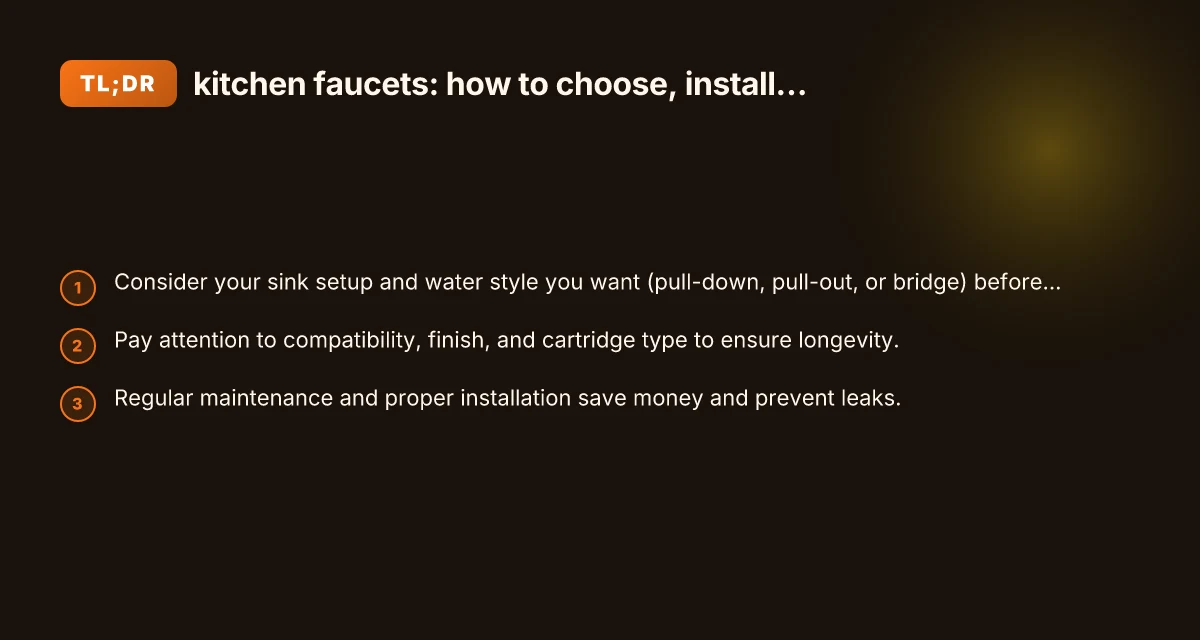
Table 2 — key features to compare
| Feature | What it affects | Typical range / notes | When it matters most |
|---|---|---|---|
| Spout height | Clearance over sink | Low/med/high | Large pots; wide sinks |
| Reach | Distance to center | Short/med/long | Deep, wide bowls |
| Number of handles | Control style | 1 handle/2 handles | Ease of use; budget |
| Sprayer type | Spray pattern | Aerated/razor/jet | Rinse vs fill tasks |
| Cartridge type | Longevity | Ceramic/ball | Maintenance ease |
| Finish | Durability & looks | Chrome/Nickel/bronze | High-traffic kitchens |
| Deck plate needs | Mounting footprint | Single hole/3-hole | Remodel constraints |
| Water efficiency | Flow rate | Standard/eco | Water savings goals |
Compiled November 2026; check the provider's site for current details.
How to choose the right faucet for your kitchen
When selecting a kitchen faucet, balance practicality with style. Use this decision checklist: Kitchen Curtains: How to Choose, Style, and Care for Your Windows
- Sink setup: How many holes? Is it deck-mounted or wall-mounted? Does your sink need high clearance?
- Task needs: Do you frequently fill large pots or use a spray head for rinsing produce?
- Maintenance: Do you prefer a cartridge with easy replacement and a durable finish?
- Style: Should the faucet match traditional or modern cabinetry and hardware?
- Budget: Set a price range and compare features, warranties, and customer reviews.
Think about the faucet as part of a larger kitchen ecosystem. The finish should complement your cabinet hardware and faucet handles. A well-chosen faucet not only looks good but also reduces clutter and makes everyday tasks smoother.
Warranty and brands to consider
- Look for warranties that cover finish and mechanical parts for at least a few years.
- Reputable brands often offer better dealer support, replacement cartridges, and readily available parts.
- Read user reviews focusing on reliability, ease of installation, and service responsiveness.
Frequently recommended brands include both boutique and mainstream options. When evaluating a brand, check:
- Availability of replacement cartridges
- Local service options for warranty claims
- Availability of finish options to match your kitchen hardware
Table 3 — installation considerations and maintenance tasks
| Consideration | Impact | Common constraints | Maintenance routine |
|---|---|---|---|
| Mounting type | Wall vs deck | Cabinet space; hole counts | Check supply lines; reseat seals |
| Supply lines | Hot/cold routing | Distance to sink; length | Inspect for leaks; replace hoses every 5–10 yrs |
| Deck thickness | Fit | Thick counters; mounting hardware | Use escutcheon or proper gasket |
| Aerator care | Flow stability | Clogs with minerals | Remove, clean, replace annual |
| Cartridge access | Serviceability | Screw-in vs snap-in | Periodic lubrication; replace worn cartridge |
| Shutoff availability | Maintenance safety | Under-sink valves | Verify before install; label lines |
Compiled November 2026; check the provider's site for current details. Kitchen countertops: choosing, installing, and caring for your perfect surface
The recommendation
If you want a reliable, versatile, and easy-to-maintain faucet for a modern kitchen, a pull-down model in a durable finish like brushed nickel or stainless steel is a strong choice. It provides ample reach, strong spray options for cleaning and rinsing, and compatibility with a wide range of sinks. Choose a single-handle model for quick temperature adjustments, unless you prefer the classic look and precise control of a two-handle design. Ensure the faucet you pick has a ceramic disc cartridge, solid brass construction, and replaceable aerator and cartridge components to maximize longevity. Finally, consider a model with a limited lifetime warranty to protect your investment.
If your kitchen leans traditional or you already have a bridge or ornate hardware, a bridge faucet in a matching finish can tie the room together while still delivering practical performance. For smaller spaces or minimalist kitchens, a compact pull-out or a slim pull-down model can deliver the needed function without crowding the sink area.
Bottom line: start with sink compatibility, determine the style that matches your cabinets, pick a high-quality cartridge and finish, and ensure you have access to parts and support. A well-chosen kitchen faucet is a long-term upgrade that improves daily life at the sink.