Furniture repair when to use professional services
A practical guide to deciding when to tackle furniture repairs yourself or hire pros.
In the world of furniture, repairs come in many forms, from a loose chair leg to a cracked veneer, from a stubborn squeak to a torn leather seat. The decision to repair yourself or hire a professional hinges on several factors: the type of furniture, the extent of damage, your skill level, the tools you have, and your budget. This guide breaks down when to roll up your sleeves and when to call in a pro, so you can protect your investment without overpaying.
When to DIY makes sense
| Situation | Skill level needed | Time investment | Cost range | Risk level | Notes |
|---|---|---|---|---|---|
| Minor cosmetic fixes | Low | Short | Low | Low | Paint touch-ups, minor scratches |
| Simple hardware replacing | Moderate | Moderate | Low | Low | Screws, knobs, hinges |
| Basic upholstery touch-ups | Moderate | Moderate | Low–Mid | Low–Moderate | Patching small tears |
| Cleaning and conditioning | Low | Short | Very Low | Low | Wood cleaners, waxes |
| Limited tool use | Moderate | Moderate | Low | Low–Moderate | Sanding, glue application |
| When uncertain | N/A | N/A | N/A | N/A | Pause and reassess |
Compiled November 2026; check the provider's site for current details.
When DIY makes sense
Simple, cosmetic fixes you can handle
There are plenty of repairs that are straightforward and low-risk if you have basic tools and patience. Consider these:
- Tightening loose screws or joints on chairs and tables
- Re-gluing a small veneer lift or chipped edge
- Replacing fabric buttons or minor seams on cushions
- Fixing squeaks with simple lubrication or tightening screws
- Patching small leather scratches with color-matched filler or wax
What you’ll need
- Basic tools: screwdriver set, hammer, glue, clamps
- Materials: wood glue, wood filler, veneer patches, fabric or leather repair kits
- Clean workspace, good lighting, and a plan to avoid making things worse
Signs you’re ready to DIY
- Damage is small and contained
- You can access online tutorials or manufacturer guides
- You’re confident in following careful steps without rushing
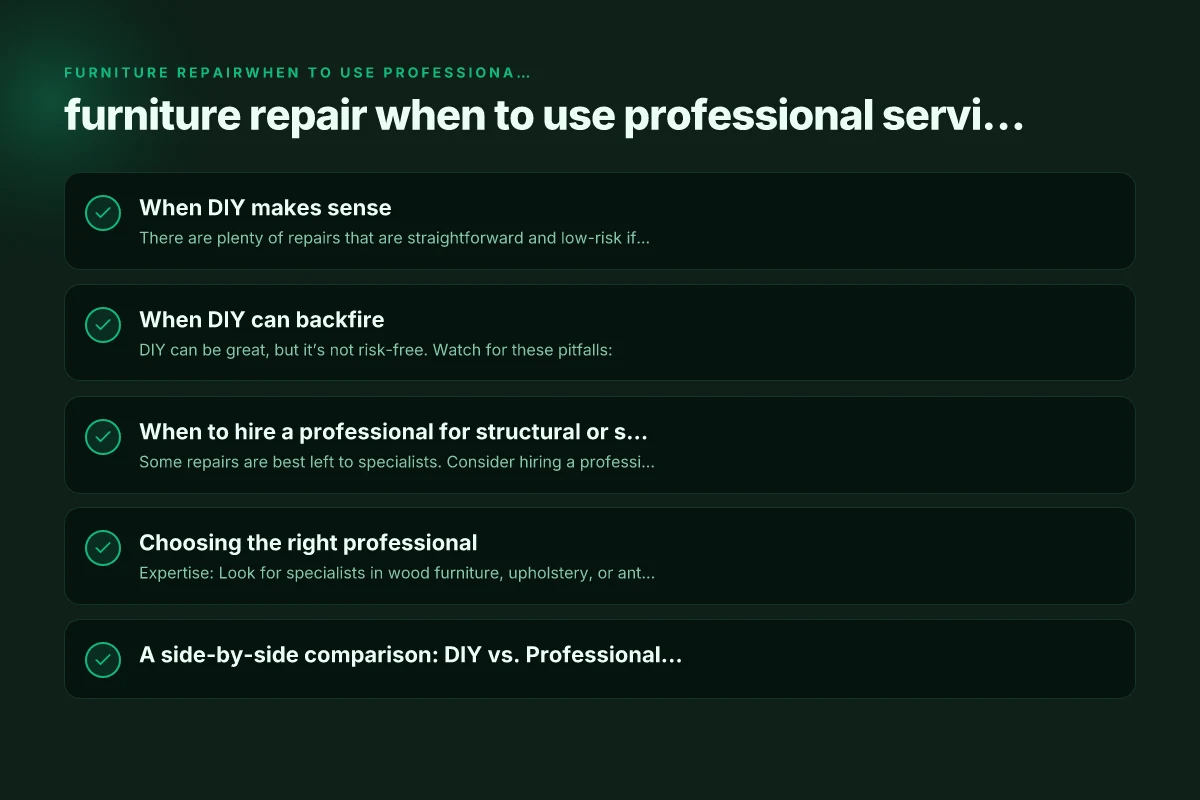
When DIY can backfire
Risks to consider
DIY can be great, but it’s not risk-free. Watch for these pitfalls:
- Permanent damage from using the wrong glue or solvent
- Staining or finish damage during refinishing
- Structural failure due to improper table or chair repair
- Voiding warranties on newer furniture
- Personal safety concerns with power tools or sharp edges
How to mitigate risks
- Test methods on an inconspicuous area first
- Use manufacturer-approved products when possible
- Work slowly and allow adequate cure time
- If in doubt about structural integrity, pause and seek guidance
When DIY can backfire
| Issue | Warning signs | Potential damage | Time impact | Cost impact | Notes |
|---|---|---|---|---|---|
| Structural load | Visible cracks or wobble | Splitting, collapse | High | High | Do not DIY |
| Electrical/metal parts | Evidence of corrosion | Fire risk, shock | High | High | Hire pro |
| Upholstery stuffing | Severe tears | Saggy or unsafe seating | High | Mid–High | Pro upholstery advised |
| Glue downs on chairs | Wood splits | Loose joints, wobble | High | Mid–High | Pro repair may be needed |
| Finishes on antique furniture | Cracking, color mismatch | Value loss | High | High | Be cautious |
| When in doubt | Any uncertainty | Unknown risk | Varied | Varied | Seek professional opinion |
Compiled November 2026; check the provider's site for current details. 4 Sectional couch features ideal for avid readers
When to hire a professional for structural or safety-critical repairs
Key scenarios where pros shine
Some repairs are best left to specialists. Consider hiring a professional if you encounter:
- Loose or cracked furniture frames (especially wood or metal frames) that affect stability
- Broken legs, joints, or rails on chairs and tables
- Structural damage to sofas, beds, or recliners that affect weight support
- Veneer peeling on tabletops or cabinet fronts where alignment matters
- Upholstery repairs requiring re-stuffing, sewing, or fabric restoration
- Antique or heirloom pieces with potential value or conservation concerns
- Electrical or mechanical components in recliners or beds (motors, springs)
What a professional typically covers
- Assessment of structural integrity
- Disassembly and safe handling of heavy pieces
- Sourcing authentic or compatible replacement parts
- Repairs that preserve warranties or improve longevity
- A written estimate and post-repair care instructions
Choosing the right professional
Factors to weigh
- Expertise: Look for specialists in wood furniture, upholstery, or antiques, depending on your piece.
- Proven results: Ask for photos or references of similar repairs.
- Warranty or guarantee: Does the shop guarantee the repair?
- Time and cost: Get a written estimate and compare with DIY costs.
- Insurance: Ensure the pro is insured in case of accidental damage.
How to find a reputable pro
- Read reviews from homeowners and businesses
- Request an in-person or virtual assessment before committing
- Ask for a written scope of work and timeline
- Verify licenses or certifications if applicable (antique furniture, upholstery, or restoration)
A side-by-side comparison: DIY vs. Professional repairs
| Criteria | DIY repair | Professional repair |
|---|---|---|
| Cost | Usually lower upfront | Higher upfront, but may be cost-effective for complex jobs |
| Time | Can be faster for small fixes | Might take longer due to scheduling and parts |
| Skill required | Moderate to high depending on task | High for structural, upholstery, or restoration |
| Tools needed | Basic to moderate | Specialty tools and parts, as needed |
| Risk to piece | Moderate risk if done carefully | Lower risk when handled by a pro |
| Warranty/coverage | May void warranty | Often includes warranty or guarantees |
| Outcome | Good for small fixes | Durable, aesthetically aligned with original |
Choosing the right professional
| Category | What to look for | Questions to ask | Expected outcomes | Credentials | Notes |
|---|---|---|---|---|---|
| Structural repair | Experience with load-bearing parts | Years, references, photos | Safe, stable furniture | Trade license, certifications | Get a written estimate |
| Safety-critical repairs | Compliance with standards | Proof of insurance, warranties | Non-hazardous, compliant | Insurance, certification | Prioritize safety |
| Upholstery & finishing | Portfolio of similar work | Materials used, turnaround | Better fit and finish | Shop rating, reviews | Request samples |
| Antique/restoration | Proven restoration outcomes | Proven restores in similar pieces | Preserve value | Appraisals, memberships | Avoid over-restoration |
| On-site vs shop | Availability, turnaround | In-home options, transport | Convenience vs cost | Local license | Consider delivery |
Compiled November 2026; check the provider's site for current details.
Practical tips to decide on the spot
- Size and exposure: Large or heavy furniture is harder to move and repair safely. Consider professional help for moves or reassembly.
- Value and sentiment: For antiques or valuable pieces, leaning toward a specialist may protect value.
- Finish and color: If a repair requires color matching or re-finishing, a professional with color-matching tools can achieve a seamless result.
- Time pressure: If you need the piece finished quickly, a pro can often complete the job more efficiently.
How to prepare for a repair visit
- Gather details: Photos of the damage, the age of the piece, and any purchase or warranty information.
- Clear the area: Move the furniture to a flat, open space with good lighting.
- Document existing conditions: Take before photos to compare with the final result.
- Ask the right questions: Availability, expected timeline, parts sourcing, and post-repair care.
Final recommendations
- Start small: If you’re unsure, begin with cosmetic or non-structural fixes to build confidence.
- Know your piece: For antique or valuable furniture, consult a restorer before attempting any repair.
- Get multiple quotes: For larger or structural repairs, obtain several opinions to compare approaches and costs.
- Prioritize safety: If a repair involves heavy lifting, power tools, or potential injury, hire a professional.
If you’re facing a stubborn or risky repair, professional services are often worth it. A qualified furniture repair specialist can restore stability, extend the life of your piece, and protect its value. For routine, cosmetic fixes, DIY can be a satisfying and budget-friendly option. By weighing the type of damage, the piece’s value, your skill level, and the time you have, you can choose the right path with confidence. Three types of camouflage furniture to buy